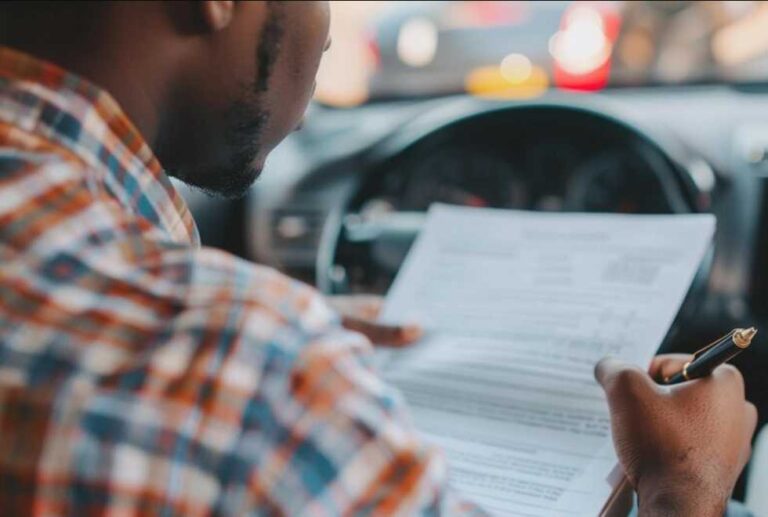
You bought a used car. The keys are yours. On paper, it still belongs to someone else.
Until you change ownership, the car is registered to the seller, and that is a problem the day it is stopped at a checkpoint, caught up in an incident, or flagged in a dispute.
Here is how to put it properly in your name.
Why this matters more than people think
A handshake and a receipt are not ownership in the eyes of the law.
If the car stays in the seller's name, a stolen-vehicle check can point at them, an accident can drag them in, and any tracker or insurance sits under the wrong identity.
Worse, a dishonest seller could later claim the car was never sold.
Change of ownership closes all of that.
Collect the seller's documents first
Before money changes hands, get the paper trail.
You want the original purchase receipt, the current vehicle papers, the seller's Proof of Ownership Certificate, and a signed sale agreement.
Confirm the chassis and engine numbers on the documents match the car in front of you.
If anything is missing or does not match, pause the deal.
The chassis number is the spine of the whole transfer. Check it against the documents before you pay a kobo.
Fill Form MVA 5
The change of ownership runs on a specific form.
Form MVA 5 is the change-of-ownership form, and it captures both parties, the vehicle details and the transaction.
The Proof of Ownership Certificate itself comes from Form MVA 1, issued by the Motor Licensing Office.
You complete these at the licensing office or through an approved agent.
Get a new Proof of Ownership and update the CMR
Now the car becomes yours on record.
Apply for a new Proof of Ownership Certificate in your name, then update the Central Motor Registry so the national database reflects the change.
This ties into the police record too, the same system behind CMRIS registration.
Once the CMR shows you as owner, a stolen-vehicle check points at you, not the previous owner.
Want your papers handled for you?
We sort vehicle registration, transfers and permits so you skip the queues. Tell us what you need.
See our vehicle papers serviceDocuments, cost and timeline
Here is the short version of what it takes.
You will need the purchase receipt, current papers, the seller's Proof of Ownership, a signed agreement, a valid roadworthiness certificate and insurance, and your ID.
The transfer fee is often around ₦5,000, though the full cost varies by state and vehicle value once fresh papers and insurance are added.
A complete transfer usually takes a few working days to about two weeks. For the wider picture of what every car should carry, see our guide to vehicle papers and permits, and if you are buying, the cost of registering a vehicle.
Protect the car you just bought
New ownership is the right moment to secure the car properly.
Once it is in your name, put the tracking, insurance and recovery under your identity too, not the seller's leftover details.
A clean transfer plus a hidden tracker means the car is yours on paper and findable in practice.
Our vehicle papers service can handle the transfer end to end if you would rather not queue.


Frequently asked questions
How do I change ownership of a car in Nigeria?
Collect the seller's documents, complete Form MVA 5, obtain a new Proof of Ownership Certificate in your name, update the Central Motor Registry and police CMRIS record, then re-register and insure the car in your name.
What documents do I need to transfer car ownership?
The original purchase receipt, the current vehicle papers, the seller's Proof of Ownership Certificate, a signed sale agreement, a valid roadworthiness certificate and insurance, plus your means of identification.
How much does change of ownership cost in Nigeria?
The transfer fee is often around N5,000, but the total varies by state and the value of the vehicle once new papers, registration and insurance are included. Confirm the current figure with your state licensing office.
How long does it take to change vehicle ownership?
The CMR update itself can be quick, but a complete transfer with new papers usually takes a few working days to about two weeks depending on the office and state.
The editorial team at Car Tracker Nigeria, drawing on two decades of vehicle tracking, recovery and fleet work across Nigeria to publish practical security guides.
Related guides.